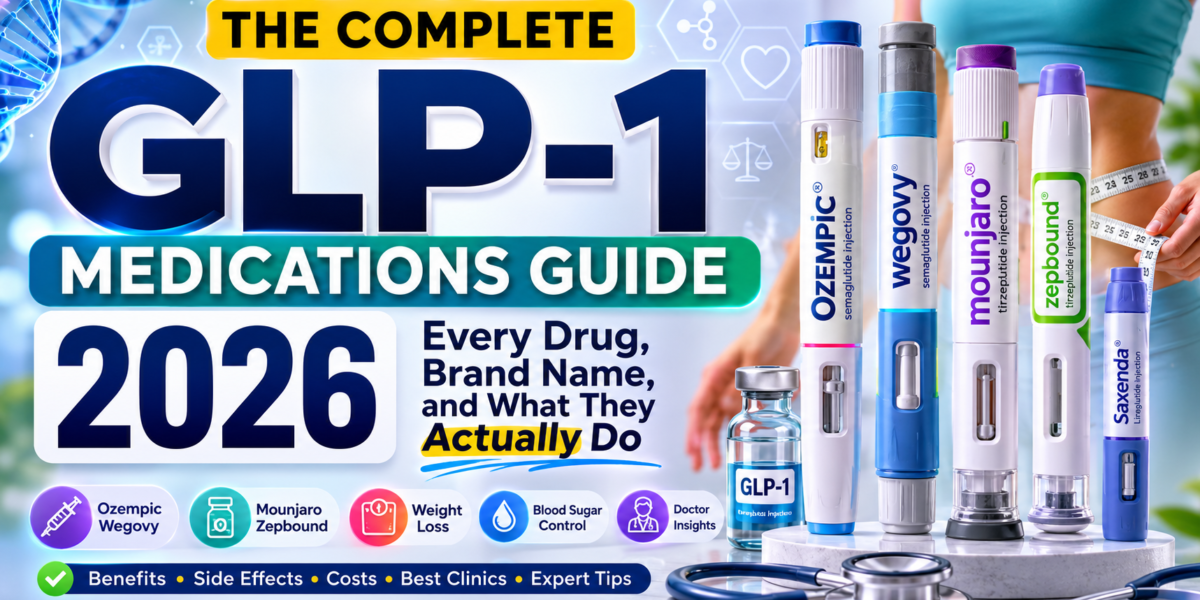
If you’ve heard the names Ozempic, Wegovy, Mounjaro, or Zepbound and felt confused about the difference, you are far from alone. They are all GLP-1 medications—but they are not the same drug. And picking the right one matters.
This guide cuts through the noise. Below, you’ll find every FDA-approved GLP-1 medication for 2026, what each does, who it’s for, real-world weight loss expectations, and how costs compare. By the end, you’ll know exactly what separates these drugs—and which one fits your situation.
What Is a GLP-1, Really?
GLP-1 stands for glucagon-like peptide-1—a natural hormone your gut releases after eating. It does three things:
- Signals your pancreas to release insulin
- Tells your brain you’re full
- Slows digestion
The result? Lower blood sugar and reduced appetite.
GLP-1 medications (agonists) artificially mimic this hormone—far more powerfully and longer than your body can. That’s why they drive such dramatic weight loss in trials: they fundamentally change how hungry you feel and how much you eat.
As of 2026, nine GLP-1 agonists have FDA approval, but three active ingredients dominate: semaglutide, tirzepatide, and liraglutide. Each ingredient has multiple brand names depending on its approved use and dosage.
The #1 Concept That Confuses Everyone
Same drug, different brand names for different conditions.
- Ozempic and Wegovy both contain semaglutide
- Mounjaro and Zepbound both contain tirzepatide
- Victoza and Saxenda both contain liraglutide
The drug is identical. The difference? Approved indication (diabetes vs. weight loss) and dosage.
Why this matters: Insurance. Ozempic is covered for diabetes. Wegovy is covered for weight loss. Same molecule, different label, completely different insurance outcome.
Semaglutide Medications (Ozempic, Wegovy, Rybelsus)
Semaglutide is the world’s most widely prescribed GLP-1. It reduces appetite, slows stomach emptying, and lowers blood sugar.
Ozempic (Semaglutide – for Diabetes)
- Dose: 0.5mg, 1mg, or 2mg once weekly (injection)
- Approved for: Type 2 diabetes + cardiovascular risk reduction
- Weight loss (not FDA-approved for this): ~4–6kg (9–13lbs) over 40 weeks in trials
- Who it’s for: Adults with type 2 diabetes. Widely prescribed off-label for weight loss, but insurance rarely covers it for that.
- Cost (no insurance): $900–$1,000/month (savings cards can reduce to ~$25)
Wegovy (Semaglutide – for Weight Loss)
- Dose: 2.4mg weekly (higher than Ozempic)
- Approved for: Chronic weight management
- Weight loss: 14.9% of body weight over 68 weeks in STEP 1 trial. New 7.2mg version shows ~20–21%.
- Who it’s for: BMI ≥30, or BMI ≥27 with a weight-related condition (hypertension, diabetes, sleep apnea)
- Cost: $1,300–$1,500/month
- 2026 update: An oral version (25mg tablet) launched early 2026—first high-dose pill for weight management.
Rybelsus (Oral Semaglutide – for Diabetes)
- Dose: 3mg, 7mg, or 14mg daily pill
- Approved for: Type 2 diabetes only
- Weight loss: More modest (~3–5% of body weight) due to lower absorption
- Who it’s for: Diabetes patients who strongly prefer to avoid injections
- Cost: $850–$950/month
Tirzepatide Medications (Mounjaro, Zepbound)
Tirzepatide is not a pure GLP-1. It’s a dual agonist that activates both GLP-1 and GIP receptors. That dual mechanism consistently outperforms semaglutide in head-to-head trials.
Mounjaro (Tirzepatide – for Diabetes)
- Dose: 2.5mg to 15mg once weekly
- Approved for: Type 2 diabetes
- Weight loss: In a real-world study of 41,000+ adults, 81.8% lost at least 5% of body weight in one year (vs. 66.5% on Ozempic). Average difference: 6.9% in favor of Mounjaro.
- Who it’s for: Adults with type 2 diabetes, especially those with insulin resistance or who plateaued on semaglutide
- Cost: $1,000–$1,200/month (savings cards can reduce to ~$25)
Zepbound (Tirzepatide – for Weight Loss)
- Dose: 2.5mg to 15mg weekly (same as Mounjaro)
- Approved for: Chronic weight management
- Weight loss: SURMOUNT-1 trial showed 20.9% over 72 weeks. SURMOUNT-5 head-to-head vs. Wegovy: ~20% (Zepbound) vs. 14% (semaglutide). As of 2026, Zepbound delivers the strongest weight loss results of any FDA-approved medication.
- Who it’s for: BMI ≥30, or BMI ≥27 with a weight-related condition
- Cost: $1,200–$1,400/month for pens. Vials are significantly cheaper (Eli Lilly introduced them to improve affordability).
Liraglutide Medications (Victoza, Saxenda)
Liraglutide came first—but requires daily injections (vs. weekly for newer options). Still relevant as a lower-cost alternative or for step therapy requirements.
Saxenda (Liraglutide – Weight Loss)
- Dose: 3mg daily
- Weight loss: ~5–8% of body weight over 56 weeks (less than semaglutide or tirzepatide)
- Who it’s for: Adults and adolescents (12+) with obesity
- Cost: $1,200–$1,400/month
Victoza (Liraglutide – Diabetes)
- Dose: 1.2mg or 1.8mg daily
- Note: Largely replaced by once-weekly semaglutide but remains available and covered for diabetes.
Other Approved (But Rarely First-Line) GLP-1s
- Trulicity (dulaglutide) – Weekly injection for diabetes. Moderate weight loss. Biosimilars emerging.
- Byetta (exenatide) – Twice daily. Rarely used today.
- Bydureon (exenatide ER) – Weekly injection. Superseded by semaglutide.
- Adlyxin (lixisenatide) – Daily injection. Minimal weight loss, limited US availability.
New in 2026: Foundayo (Orforglipron)
Foundayo is a once-daily oral GLP-1 approved for chronic weight management. Unlike Rybelsus, it’s a small-molecule drug that doesn’t have absorption challenges.
- Weight loss: ~11% over 36 weeks (less than Wegovy/Zepbound, but significant for a daily pill)
- Who it’s for: People who want no injections and accept lower efficacy for convenience
Side-by-Side Comparison
| Brand | Active Ingredient | Frequency | Approved For | Typical Weight Loss | Approx. Cost (No Insurance) |
|---|---|---|---|---|---|
| Ozempic | Semaglutide | Weekly injection | Diabetes | 10–15% | $900–1,000 |
| Wegovy | Semaglutide | Weekly injection | Weight loss | 15–17% | $1,300–1,500 |
| Rybelsus | Semaglutide | Daily pill | Diabetes | 3–5% | $850–950 |
| Mounjaro | Tirzepatide | Weekly injection | Diabetes | 15–22% | $1,000–1,200 |
| Zepbound | Tirzepatide | Weekly injection | Weight loss | 20–22% | $1,200–1,400 |
| Saxenda | Liraglutide | Daily injection | Weight loss | 5–8% | $1,200–1,400 |
| Foundayo | Orforglipron | Daily pill | Weight loss | ~11% | TBC |
Which GLP-1 Is Right for You?
Ask yourself three questions: Primary goal? Insurance situation? Injection tolerance?
- For maximum weight loss, no budget constraints: Zepbound (tirzepatide) – strongest results available.
- For strong results at lowest cost: Compounded semaglutide through a licensed telehealth clinic (~$99–$150/month).
- For type 2 diabetes with insurance coverage: Ozempic or Mounjaro (likely covered). Ask your doctor about dosing.
- For no injections: Rybelsus (diabetes) or Foundayo (weight loss). Foundayo delivers better weight loss.
- For tight budget: See our Best GLP-1 Clinics page for current compounded pricing.
A Note on Compounded GLP-1s (2026 Update)
From 2023–2025, compounded semaglutide and tirzepatide were widely available during FDA shortages. As of 2026, the FDA has taken enforcement action on compounded semaglutide following supply normalization. Availability is changing rapidly.
If you’re researching compounded options, confirm current availability directly with your chosen clinic before deciding.
The Bottom Line
GLP-1 medications are the most effective non-surgical weight loss treatments ever approved.
- Semaglutide (Ozempic, Wegovy) activates one receptor → 10–17% weight loss.
- Tirzepatide (Mounjaro, Zepbound) activates two receptors (GLP-1 + GIP) → 15–22% weight loss. Tirzepatide wins on efficacy in every head-to-head trial.
- The diabetes and weight-loss versions of the same drug are identical—the difference is dose, indication, and insurance coverage.
For most people without insurance in 2026, the fastest and most affordable path is a telehealth clinic offering compounded semaglutide or tirzepatide—though availability depends on FDA regulations.
Frequently Asked Questions
What’s the strongest GLP-1 in 2026?
Zepbound (tirzepatide 15mg): ~20–22% weight loss over 72 weeks.
Is Ozempic the same as semaglutide?
Yes. Ozempic is the brand name for semaglutide for diabetes. Wegovy is the same molecule for weight loss.
Can I get a GLP-1 without insurance?
Yes, many people use telehealth clinics for compounded versions at much lower cost.
How long do you stay on these meds?
Long-term. Most patients who stop regain significant weight within 12 months.
Are they safe?
Generally yes, with extensive safety data (semaglutide since 2012). Common side effects: nausea, diarrhea, constipation. Serious side effects (pancreatitis, gallbladder issues) are rare.
What’s the difference between GLP-1 for diabetes vs. weight loss?
Often the exact same active ingredient. The differences: FDA-approved indication, maximum dose, and insurance coverage. Wegovy and Zepbound are higher-dose versions of Ozempic and Mounjaro, marketed specifically for weight management.